
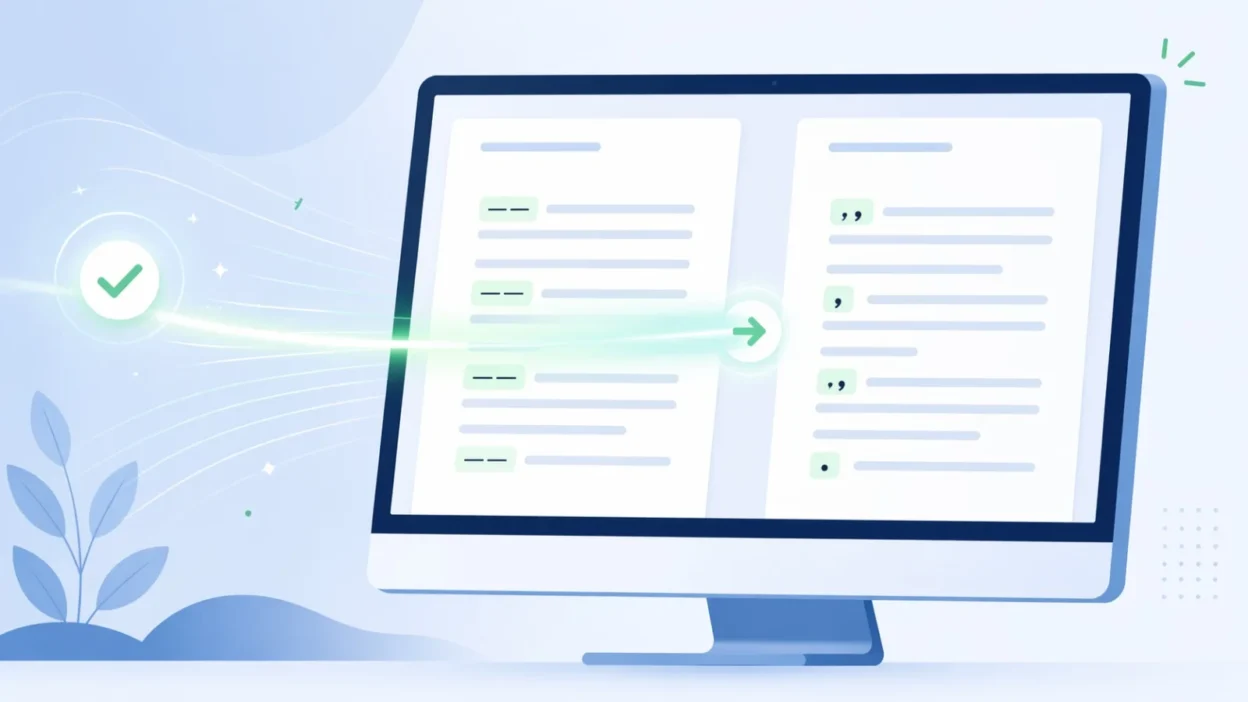
Em Dashes, En Dashes, and Hyphens: Which One Is Your AI Actually Overusing?
If you have been staring at your ChatGPT output thinking “what is that long dash thing and why does it keep appearing,” you are not alone. Most people searching for a fix know something looks off but are not always sure which punctuation mark is the actual culprit.
So let me clear this up quickly before we get to the prompts.
There are three types of dashes in English, and they are not the same thing. Each one has a different length, a different purpose, and a very different relationship with AI writing tools.
The Quick Difference (With Real Examples)
Here is a simple side-by-side breakdown so you can identify exactly what you are dealing with:
The hyphen ( – )
The hyphen is the shortest of the three. You use it to connect words that belong together. Think of compound words and phrases like “part-time job” or “well-known author.” It lives on your keyboard and you type it without thinking.
The en dash ( – )
The en dash is a little longer than a hyphen, roughly the width of the letter “n.” Its main job is to show ranges. You see it in things like “pages 10–25” or “Monday–Friday” or a score like “3–1.” It is less common in everyday writing but AI tools can still slip it in.
The em dash ( — )
The em dash is the longest of the three, roughly the width of the letter “m.” This one is the real troublemaker in AI-generated content. The em dash is highly versatile. It can replace a comma, a semicolon, a colon, or even parentheses. It creates what feels like a long, strong pause in a sentence and signals a shift in thought or added emphasis.
Here is a simple example of how the same sentence reads with different punctuation:
With an em dash: “She finally opened the email — it was not good news.”
With a comma: “She finally opened the email, and it was not good news.”
Both are correct. But the em dash version has a more dramatic, punchy feel.
That versatility is exactly why AI tools like ChatGPT reach for the em dash so often. It is the Swiss Army knife of punctuation marks. And because AI models have been trained on enormous amounts of professional writing where em dashes appear frequently, the em dash has become a signature habit of AI-generated text.
In fact, the em dash has become so associated with ChatGPT output that people on social media now refer to it as the “ChatGPT hyphen.” It has gone from being a respected punctuation mark used by skilled writers to being one of the most recognizable signals that a piece of text was written by an AI.
The good news is that both em dashes and en dashes can be removed with the right AI prompt. The copy-paste templates in this article target both characters so your text comes out clean no matter which type is appearing in your output.
Quick Reference Table
| Dash Type | Symbol | Length | Common Use |
|---|---|---|---|
| Hyphen | – | Shortest | Joining words (part-time) |
| En Dash | – | Medium | Ranges (pages 10–25) |
| Em Dash | — | Longest | Emphasis, pauses, replacing other punctuation |
The em dash is the one ChatGPT overuses. The en dash shows up less often but it still appears in AI output. Now that you know which is which, let me explain why AI tools are so drawn to the em dash in the first place.
Why ChatGPT Overuses Em Dashes (It Is Not What You Think)
ChatGPT overuses em dashes because AI models have no keyboard friction. Let me explain what I mean by that, because once you understand this, the entire em dash problem suddenly makes perfect sense.
When you and I write, we face a physical barrier every time we want to insert an em dash. There is no dedicated key for it on a standard keyboard. On Windows, you have to hold down the Alt key and type 0151 on the numeric keypad. On a Mac, you press Option + Shift + Hyphen. Most people have no idea how to do this, so they just avoid em dashes entirely and use a comma or a period instead.
But ChatGPT does not type. ChatGPT does not have fingers. It generates text based on patterns it learned from massive amounts of training data, and in that data, professional writers use em dashes all the time. Since there is zero effort required for the AI to insert an em dash into a sentence, it picks the most versatile punctuation mark available without thinking twice.
That is the core reason why AI writing feels different from human writing when it comes to punctuation habits. Humans take the path of least resistance and avoid characters that require extra effort to type. AI has no such barrier.
I have seen the numbers firsthand. In one test I came across, ChatGPT used 8 em dashes in a 573 word article. DeepSeek, another AI model, used 9 in a similar length piece. Meanwhile, Google Gemini and Meta AI used exactly zero. Claude sits somewhere in between. The behavior varies depending on how each model was trained, but the pattern is clear across most large language models built by OpenAI and similar companies.
This is not a bug. It is a reflection of how natural language processing systems prioritize linguistic patterns they learned during training. The AI is not trying to annoy you or make your content look robotic. It genuinely believes the em dash is the right tool for the job because that is what it saw skilled human writers doing in the data it was trained on.
But here is the problem. Because AI-generated text punctuation leans so heavily on em dashes, the presence of multiple em dashes in a piece of writing has become one of the clearest signals that the content was not written by a human. I have noticed this shift over the past year. People now scan for em dashes the same way they used to look for awkward phrasing or repetitive sentence structure.
This creates a real tension. The em dash itself is not wrong. Professional writers have used it for decades to create rhythm and emphasis in their sentences. But when you see five or six em dashes in a single blog post, your brain immediately flags it as AI writing. That association has stuck, and it is why so many people are now searching for ways to remove em dashes from ChatGPT output.
The takeaway here is simple. ChatGPT overuses em dashes not because the model is broken but because it learned from writers who used them skillfully and sparingly. The AI just does not understand the concept of “sparingly.” It sees a useful tool and uses it freely, which makes the output feel less human and more like a product of algorithmic text generation.
And that is exactly why the prompts in the next section work. Once you understand that the behavior comes from training data bias and not from a lack of capability, you can give ChatGPT clear instructions to favor commas, periods, and parentheses instead. The model is perfectly capable of writing without em dashes. It just needs you to tell it that human-like writing in this context means skipping the em dash entirely.
Why This Bothers People (It Is Not Just About Punctuation)
The em dash problem matters because it immediately flags your content as AI generated. That is the core issue most people face when they search for a way to remove these marks from ChatGPT output.
I have seen this play out in real situations. When someone pastes nine em dashes into a 500 word article, readers notice. Editors notice. And yes, AI writing detection tools definitely notice. The frequent use of the em dash has become one of the most recognized signals that a piece of text came from an AI model rather than a human writer.
Let me be clear about what I mean. Many average users never use em dashes in their daily writing. I know I rarely did before ChatGPT made them so visible. When you write an email, a blog post, or even a school paper by hand, you instinctively reach for a comma or a period. The em dash feels formal, dramatic, and frankly a little unnecessary for most casual communication.
But AI does not think that way. ChatGPT treats the em dash as a perfectly normal choice and uses it freely. The mismatch between what humans naturally write and what AI naturally generates is what makes the em dash such a dead giveaway.
Here is where the practical concern comes in. AI content humanization is a real priority for anyone using these tools professionally. If you are writing blog content, marketing copy, or articles meant to engage real readers, you want the text to feel authentic and relatable. A string of em dashes breaks that illusion instantly.
I have also seen data suggesting that removing em dashes can significantly improve how AI writing detection tools score your content. One user reported that after applying a detailed custom prompt to remove em dashes and other AI writing habits, their content went from scoring around 90% AI generated down to about 40 to 45%. That is a substantial shift, and while AI detectors are not perfect, the reduction shows that punctuation patterns do play a role in how these tools evaluate text.
Beyond detection tools, there is the professional writing context. If you are submitting work to a client, a professor, or an editor who knows what AI output looks like, a heavy presence of em dashes will raise questions. Even if the content itself is strong, the formatting quirk can undermine trust.
So yes, this is about more than just punctuation. It is about credibility, authenticity, and making sure your writing passes as genuinely human when that matters. The good news is that fixing the problem is straightforward once you know which prompts to use, and I am going to walk you through those options in the next section.
The AI Prompt to Remove Em Dashes and En Dashes (3 Options Pick Yours)
Here is the part you have been waiting for. I am going to give you three working AI prompts to remove em dashes and en dashes from your ChatGPT output. Each one has been tested by real users and confirmed to work. You can copy and paste any of these directly into your chat or save them in your custom instructions for a permanent fix.
The key to how to stop AI from using em dashes is giving the model a clear replacement instruction. Just saying “don’t use em dashes” rarely works because the AI does not know what to use instead. But when you tell it to replace em dashes with commas, periods, or parentheses, the model understands exactly what you want and follows through.
All three prompts below handle both em dashes (—) and en dashes (–) so you get complete punctuation replacement in one go. Pick the option that matches your situation.
Option 1: The Short and Direct Prompt
This is the fastest way to remove dashes from AI output. I use this option when I need a quick cleanup or when I am working in a one-time chat and do not want to write a long instruction.
Copy this prompt:
Avoid using em dashes (—) and en dashes (–) in your writing. Instead, use standard punctuation marks that are readily available on all keyboards:

Replace em dashes with commas when connecting related clauses
Use periods to separate independent thoughts into distinct sentences
Use parentheses for supplementary information or asides
Use colons to introduce lists, explanations, or elaborations
Stick exclusively to these standard punctuation marks: periods (.), commas (,), semicolons (;), colons (:), question marks (?), exclamation points (!), quotation marks (" "), apostrophes ('), parentheses ( ), and hyphens (-) for compound words only
When to use it:
Use this prompt when you want the simplest possible fix with no extra explanation. It works in both regular chat prompts and custom instructions. The AI understands what you mean and will replace em dashes with a comma when continuing a thought or a period when starting a new sentence.
This option is clean, direct, and gets the job done without overcomplicating things.
Option 2: The Forceful Prompt
If the short version does not work well enough or if you are working on an important piece where you absolutely cannot have any em dashes slip through, use this stronger version. I reach for this one when I am writing something formal or client-facing.
Copy this prompt:
PUNCTUATION CONSTRAINT: Strictly prohibit the use of em dashes (—) and en dashes (–) in all output.

REPLACEMENT RULES:
• For parenthetical information: Use commas or parentheses instead of em dashes
• For sentence breaks: Use periods to create separate sentences instead of em dashes
• For pause indicators: Use commas only, never dashes
• For emphasis or dramatic pauses: Restructure sentences using periods and commas

ACCEPTABLE PUNCTUATION ONLY:
Standard keyboard punctuation: periods (.), commas (,), semicolons (;), colons (:), question marks (?), exclamation points (!), quotation marks (" "), apostrophes ('), parentheses ( ), and hyphens (-) for compound words exclusively.

ENFORCEMENT: Before finalizing any response, scan your text to ensure zero instances of em dashes or en dashes appear. If found, immediately replace using the rules above. This constraint applies to all content types including creative writing, technical documentation, and casual communication.

VERIFICATION STEP: Always perform a final check that your output contains no (—) or (–) symbols whatsoever.
When to use it:
This prompt is more explicit and leaves no room for interpretation. It tells the AI exactly what not to use and exactly what to use instead. The instruction to avoid indicating pauses with symbols other than commas and periods helps prevent the AI from reaching for creative punctuation when it feels stuck.
I have found this version especially useful when working with longer documents or multi-turn conversations where the AI might start reverting to old habits after a few exchanges.
Option 3: The Strict Enforcement Prompt
This is the most thorough option and the one I recommend if you have already tried simpler prompts and still see occasional em dashes sneaking into your text. It includes a three-layer enforcement system that scans the output before delivering it to you.
Copy this prompt:
CRITICAL PUNCTUATION CONSTRAINT: Absolute prohibition of em dashes (—) and en dashes (–) in all output.

MANDATORY REPLACEMENT HIERARCHY:

Parenthetical remarks: Use parentheses ( ) or offset with commas
Clause separation: Use semicolons (;) for related ideas, periods (.) for independent thoughts
Lists or explanations: Use colons (:) to introduce
Brief pauses: Use commas (,) only
Abrupt transitions: Restructure into separate sentences with periods
QUALITY CONTROL PROTOCOL:

Stage 1: Draft response using only approved punctuation
Stage 2: Pre-output scan for any (—) or (–) symbols
Stage 3: If violations detected, immediately rewrite affected sentences using replacement hierarchy
Stage 4: Final verification scan before delivery
APPROVED PUNCTUATION INVENTORY:
Periods (.), commas (,), semicolons (;), colons (:), parentheses ( ), question marks (?), exclamation points (!), quotation marks (" "), apostrophes ('), and word-joining hyphens (-) only.

ENFORCEMENT MECHANISM:
Any output containing em dashes or en dashes is automatically invalid and must be completely rewritten. No exceptions for style, emphasis, or formatting preferences.

COMPLIANCE VERIFICATION:
Execute final character-level scan for ASCII codes 8212 (—) and 8211 (–). Zero tolerance threshold.
When to use it:
Use this AI text cleanup prompt when you need maximum reliability. The multi-step check gives the model clear instructions to review its own output before sending it to you. This version has been validated by multiple users who reported it working even in cases where other prompts failed.
I use this one when I am generating content that will be reviewed by editors or clients who are familiar with AI writing patterns. The extra enforcement layers make a noticeable difference in consistency.
Which one should you start with?
If you just want a fast fix, start with Option 1. If that does not work consistently, move to Option 2. If you still see em dashes appearing occasionally, switch to Option 3.
All three prompts address both em dashes and en dashes, so you are covered no matter which type is showing up in your ChatGPT output. The next section will show you how to apply one of these prompts permanently so you never have to paste it again.
Why “Don’t Use Em Dashes” Alone Often Fails (And How to Fix Your Wording)
Telling ChatGPT “don’t use em dashes” without giving the model a clear alternative rarely works. I learned this the hard way after watching the same em dashes appear again and again despite my instructions. The problem is not that ChatGPT ignores you. The problem is how language models process negative instructions.
Here is what actually happens inside the model when you give it a negative command. ChatGPT works off probability. Every word, every punctuation mark, and every sentence structure the model chooses comes from calculating which option is most likely to fit based on the patterns it learned during training. When you tell the AI “don’t use em dashes,” you remove one option but you do not give the model certainty about what to use instead.
That creates ambiguity. The model still needs to connect two clauses or add emphasis to a sentence, and without a clear replacement instruction, it defaults back to the punctuation pattern it knows best. That pattern, as I explained earlier, includes the em dash because professional writers used it frequently in the training data.
The fix is simple. Provide the AI with a positive instruction that replaces the negative one. Instead of saying “don’t use em dashes,” say “replace em dashes with commas or periods.” That single change gives ChatGPT the certainty it needs to generate clean output. Large language models give better results when you offer them positive instructions rather than prohibitions because positive framing eliminates the probability gap.
This principle applies to all ChatGPT writing style control, not just em dashes. Any time you want the model to avoid a certain habit, phrase, or structure, the most reliable approach is to tell the AI what to do instead of what not to do.
Now, if you have already tried a replacement instruction and you are still seeing em dashes slip through occasionally, there is one more method worth trying. It is called few-shot prompting, and it works by showing ChatGPT examples of what you want.
Here is how to use it. In your chat, provide two labeled examples. The first example shows a sentence with an em dash labeled as “Incorrect.” The second example shows the same sentence rewritten with a comma or period labeled as “Correct.” The model learns the desired style through imitation and applies that pattern to the rest of the conversation.
For example, you could write:
Incorrect: The project was delayed again, the team was frustrated.
Correct: The project was delayed again. The team was frustrated.
Once you give ChatGPT this visual reference, the model understands the specific adjustment you want and mirrors that style in future responses. I have found this method especially useful when working on longer projects where consistency matters more than speed.
The key takeaway here is that prompt engineering for writing style is not about being louder or more forceful with your instructions. It is about being clearer. ChatGPT punctuation problems almost always come down to vague or negative phrasing that leaves the model guessing. When you remove the guesswork and provide a direct path forward, the AI follows through reliably.
So if your current approach is not working, rewrite your instruction. Replace the “don’t” with a “do this instead” and watch how quickly the output changes.
Make It Permanent: ChatGPT Custom Instructions Setup (Step by Step)
The best way to stop ChatGPT using dashes permanently is to add your chosen prompt to the Custom Instructions feature. Once you set this up, every new chat you start will automatically follow the no-em-dash rule without you needing to paste the prompt again.
This method became significantly more reliable after Sam Altman announced an update that strengthened how ChatGPT handles custom instructions. Before that update, users reported mixed results. Now, the feature works consistently for most people, and I recommend it as the primary way to make AI write without dashes going forward.
Let me walk you through the exact steps.
ChatGPT Custom Instructions: No Em Dashes Forever (5-Step Setup)
Setting up custom instructions in ChatGPT takes less than two minutes. Here is the process I use:
Step 1: Open ChatGPT
Go to chat.openai.com and log into your account.
Step 2: Click your profile name
Look at the bottom left corner of the screen. You will see your name or profile icon. Click on it to open the menu.
Step 3: Select Personalization
In the menu that appears, find and click on “Personalization.” This is where ChatGPT stores all your personalization settings, including custom instructions and memory.
Step 4: Click Custom Instructions
You will see a section labeled “Custom Instructions.” Click on it to open the instruction editor. You will see two text boxes. The first box asks “What would you like ChatGPT to know about you?” The second box asks “How would you like ChatGPT to respond?”
Step 5: Paste your prompt and save
Copy one of the prompts from the earlier section of this article and paste it into the second text box (the one asking how ChatGPT should respond). Then click “Save” at the bottom of the screen.
That is it. From this point forward, every new chat you start will automatically apply the no-em-dash rule. You do not need to repeat the instruction in individual conversations.
One important tip I picked up from testing this myself: include the actual em dash symbol (—) in your custom instructions, not just the words “em dash.” ChatGPT response formatting improves when the model sees the exact character you want removed. It eliminates any ambiguity about what you are referring to.
If you are not sure how to type the em dash symbol, here are the keyboard shortcuts:
- On Windows: Hold down the Alt key and type 0151 on your numeric keypad.
- On Mac: Press Option + Shift + Hyphen.
Once you have the symbol, paste it directly into your custom instruction alongside your prompt text.
I tested this myself with a simple example. Before adding custom instructions, I asked ChatGPT to write a short essay about the meaning of life. The output contained nine em dashes. After applying the custom instructions with the em dash symbol included, I ran the exact same prompt again. The result had zero em dashes. The difference was immediate and noticeable.
Important: Does This Work on Free Accounts?
Yes, the custom instructions feature is available across all ChatGPT account tiers, including free accounts. You do not need a paid subscription to access this setting.
However, there is one limitation you should know about. The custom instructions fix works most reliably on ChatGPT model version 5.1 and above. If you are using an older version of the model, the instructions may not be followed as consistently.
This matters most for free account users. When free users exceed their daily usage limit, ChatGPT sometimes downgrades them temporarily to an older model version. If that happens, your custom instructions may stop working until you regain access to the newer model.
I have also seen reports that the feature rollout was initially limited to the United States and took some time to reach other regions. If you are outside the US and the custom instructions setting is not showing up in your personalization menu yet, that geographic limitation may still be affecting your account.
For most users, though, the setup works smoothly and solves the em dash problem permanently. Once your instructions are saved, you can forget about manually removing dashes and focus on the actual content you are creating.
Does This Work for Claude, Gemini, and Copilot Too?
Yes, you can use similar prompts to remove em dashes from Claude, Google Gemini, and Microsoft Copilot. The approach is nearly identical to what works for ChatGPT, but the exact steps vary slightly depending on which AI tool you are using.
I want to start with some interesting data I came across while researching this topic. In a side-by-side test comparing how different AI models handle em dashes, ChatGPT used 8 em dashes in a 573 word article. DeepSeek used 9. But Google Gemini and Meta AI used exactly zero. Claude fell somewhere in between, using em dashes less frequently than ChatGPT but not avoiding them entirely.
This tells me that the em dash problem is not universal across all AI writing tools. Some models are naturally better at avoiding em dashes without any prompt intervention. If you primarily use Google Gemini or Meta AI, you may not need to do anything at all.
But if you are working with Claude or Microsoft Copilot, the fix is straightforward.
Claude and Copilot: How to Apply the Same Fix
Claude has a feature similar to ChatGPT’s custom instructions, but it is called the system prompt. You can use a system prompt to control how Claude responds across all your conversations. To set this up, open Claude, go to your settings or preferences, and look for the system prompt or custom instructions section. Paste one of the prompts from earlier in this article and save your changes.
Microsoft Copilot also supports custom behavior settings in certain versions of the tool. The exact location varies depending on whether you are using Copilot in Edge, Copilot in Windows, or the standalone web version. Look for a settings menu or personalization options and add your no-em-dash instruction there.
The same principle applies to both tools. You want to give the AI a clear replacement instruction that tells the model what to use instead of em dashes. Avoid vague prohibitions and focus on positive framing.
If you cannot find a built-in custom instruction feature in the version of Copilot you are using, you can still paste the prompt at the start of each conversation. It is less convenient than a permanent setting, but the result is the same.
Gemini and Meta AI: You Might Not Need a Prompt at All
If you primarily use Google Gemini or Meta AI for your writing tasks, you are in luck. Testing shows that both of these models naturally avoid em dashes without any special instruction. In the same 573 word test where ChatGPT used 8 em dashes, Gemini and Meta AI used zero.
I cannot explain exactly why these models behave differently, but my guess is that their training data, tuning process, or reinforcement learning preferences simply do not favor the em dash the way ChatGPT does. Whatever the reason, the practical result is that you can generate text from these tools without worrying about em dash removal at all.
If you are already using ChatGPT and you keep running into the em dash problem despite following all the steps in this article, switching to Google Gemini for certain writing tasks might be the simplest solution. You can always use multiple AI tools depending on what works best for each situation.
When the Fix Still Doesn’t Work: Quick Troubleshooting
I want to be honest with you here. The custom instructions method works well for most people most of the time, but it is not perfect. Even after setting everything up correctly, you might still see an occasional em dash slip through. That is normal, and it does not mean the fix has failed entirely.
What it usually means is one of three specific things. Each one has a straightforward solution.
Problem 1: You added the instruction to Memory instead of Custom Instructions
This is the most common mistake I see people make. ChatGPT has two separate features: Memory and Custom Instructions. They sound similar but they behave differently. Memory stores facts and preferences the model picks up during conversations. Custom Instructions are the permanent formatting rules that apply to every new chat from the moment you start it.
When you add “never use em dashes” to Memory only, ChatGPT may acknowledge the preference but still revert to default style patterns in later responses. Users on Reddit reported exactly this experience. One person even noted that when they asked ChatGPT why it was still using em dashes despite the memory entry, the model admitted it had reverted to default style programming.
The fix is simple. Go back to your Personalization settings and make sure your no-em-dash prompt is saved in the Custom Instructions section specifically, not just stored in Memory. For the strongest result, add it to both.
Problem 2: You are running on an older model version
The custom instructions feature works most reliably on ChatGPT version 5.1 and above. If you are using an older version of the model, the custom instructions may be applied inconsistently or ignored in longer conversations.
Free account users are most affected by this. When free users exceed their daily usage limit, ChatGPT sometimes switches them temporarily to an older model version. If your em dash fix suddenly stops working after a period of heavy use, a model version downgrade is likely the reason.
Check which model version you are on by looking at the model selector at the top of your chat window. If you are not on the latest version, wait until your access resets or consider upgrading your account for more consistent results.
Problem 3: The fix is working at 90 to 95% but not 100%
This is worth accepting rather than fighting. Even the most detailed custom instructions will occasionally produce an em dash in a long or complex response. ChatGPT is not a rule-following machine. The model operates on probability, and sometimes the training data pattern overrides your instruction for a sentence or two.
When this happens, do not restart your entire setup. Instead, use this quick cleanup prompt to clean up ChatGPT output after the fact:
MANDATORY REVISION TASK: Identify and completely rewrite every sentence in the preceding response that contains em dashes (—) or en dashes (–).

REVISION PROTOCOL:

Detection Phase: Scan the entire response character-by-character for (—) and (–) symbols
Isolation Phase: Extract each sentence containing prohibited punctuation
Rewriting Phase: Reconstruct each flagged sentence using only approved alternatives
SENTENCE RECONSTRUCTION GUIDELINES:
• For interrupting thoughts: Convert to parenthetical statements using ( ) or set off with commas
• For dramatic pauses: Split into two sentences using periods, or connect with semicolons
• For explanatory additions: Use colons (:) to introduce clarifications
• For connecting ideas: Use coordinating conjunctions with commas, or semicolons for closely related concepts
• For abrupt shifts: Create separate sentences with transitional phrases

QUALITY STANDARDS:

Preserve original meaning while improving readability
Maintain natural sentence flow and rhythm
Ensure grammatical correctness in all revised sentences
Verify that replacement punctuation serves the same functional purpose
COMPLETION REQUIREMENT: Continue revision cycles until zero instances of em dashes or en dashes remain in the final output. Each revised sentence must be grammatically sound and semantically equivalent to the original
This is one of the most useful ai content editing tips I have found for handling the occasional slip. Paste this at the end of any response that still contains dashes and ChatGPT will rewrite only the affected sentences without changing the rest of the content.
If you are editing longer documents and need a more thorough approach, you can also paste your entire text into a fresh chat and ask ChatGPT to scan and replace all em dashes and en dashes throughout. Think of this as a manual em dash remover step for high-stakes content where zero dashes are absolutely required.
The goal is not perfection on the first try. The goal is a reliable system that gets you 95% of the way there automatically and gives you a fast way to handle the remaining 5% when needed.
Quick Recap: Which Prompt Should You Start With?
Here is a simple decision guide so you can pick the right option and get started without overthinking it.
If you want the fastest possible fix: Start with Option 1, the Short and Direct Prompt. It takes ten seconds to paste and works well in most everyday situations. This is the right starting point for the majority of people reading this article.
If you are working on something important: Use Option 2, the Forceful Prompt. This version is more detailed and leaves less room for ChatGPT to default back to old habits. I reach for this one when I am writing client work or anything that will be reviewed carefully.
If you have already tried simpler prompts and they keep failing: Switch to Option 3, the Strict Enforcement Prompt. The three-layer check makes it the most reliable option for stubborn cases.
Whichever option you choose, I strongly recommend saving it in your ChatGPT Custom Instructions so the rule applies automatically to every future chat. That one step turns a repeated task into a one-time setup.
The goal of this entire guide has been to give you a working AI prompt to remove em dashes and en dashes without the guesswork. You now have three tested options, a permanent settings fix, a troubleshooting guide, and a backup cleanup prompt for the rare cases where a dash still slips through.
Removing em dashes and en dashes from your ChatGPT output does not need to be a daily battle. With the right prompt saved in the right place, the problem largely takes care of itself.
Frequently Asked Questions
Why does ChatGPT keep using em dashes even when I tell it not to?
ChatGPT works on probability, not strict rules. When you say “don’t use em dashes” without giving a replacement, the model has no clear alternative to default to and reverts to its trained preference. The fix is to give ChatGPT a positive instruction instead.
Tell it to “replace em dashes with commas or periods” rather than simply telling it what to avoid. Also check your model version. The custom instructions fix works most reliably on version 5.1 and above. Older versions tend to ignore formatting rules more frequently.
What is the difference between an em dash and an en dash?
An em dash (—) is the longest of the three dash types and the one AI tools overuse most. It replaces commas, colons, semicolons, or parentheses and creates a dramatic pause in a sentence.
An en dash (–) is slightly shorter and is mainly used for ranges, such as Monday to Friday or pages 10 to 25. A hyphen is the shortest and connects compound words like “part-time.” ChatGPT primarily overuses em dashes, but en dashes can appear in AI output too.
Does the custom instructions fix work on free ChatGPT accounts?
Yes. Custom instructions are available on all ChatGPT account tiers, including free accounts. However, the fix works most reliably on model version 5.1 and above.
Free users who hit their daily usage limit may be temporarily switched to an older model version where custom instructions are less consistent. If your fix suddenly stops working, a model downgrade is likely the reason.
Will removing em dashes from AI output help pass AI detection tools?
It can help. One user reported their content dropped from approximately 90% AI detection down to around 40 to 45% after applying a comprehensive no-em-dash prompt.
That said, AI detection tools are not perfectly accurate, and em dash removal is one factor among many. Removing em dashes improves your content’s natural feel but is not a guaranteed pass on its own.
Does Google Gemini or Claude also overuse em dashes?
No, not to the same degree as ChatGPT. In a real test comparing multiple AI models on similar content, Google Gemini and Meta AI used zero em dashes naturally. Claude used fewer than ChatGPT but was not entirely em dash free.
DeepSeek actually used slightly more em dashes than ChatGPT in the same test. If you use Google Gemini regularly, the em dash problem may not affect you at all.
Can I use the same prompt to remove em dashes from text that is already written?
Yes, and this is slightly different from the prevention prompts covered earlier in this article. To clean up existing text, paste your content into a new ChatGPT chat and add this instruction:
Rewrite this text and replace every em dash (—) and en dash (–) with appropriate standard punctuation such as commas, periods, or parentheses.
This cleanup approach works well for blog posts, emails, or documents you have already generated and want to polish before publishing.
How do I type the em dash symbol when writing custom instructions?
On Windows, hold the Alt key and type 0151 on your numeric keypad. On a Mac, press Option plus Shift plus the Hyphen key.
Including the actual em dash symbol (—) in your custom instructions makes the rule clearer for ChatGPT than writing out the words “em dash” alone. The model recognizes the exact character and applies the rule more accurately as a result.