
Why Most Cold Emails Get Ignored (And What Claude Does Differently)
Most cold emails get deleted before they are even fully read. Not because the sender has nothing valuable to offer. But because the email itself gives the recipient no real reason to keep reading past the first sentence.
I built a Claude prompt for cold email outreach that fixes this problem completely. Below you will find the full prompt free to copy and paste along with a real before and after example that shows exactly what changes when you use it.
If you have been searching for free AI email prompts or wondering how to use Claude to write emails that actually get replies, this is the only guide you need. No fluff. No theory without proof. Just a working Claude AI email prompt you can paste into claude.ai right now and start sending better cold emails today
I have been on both sides of this. I have sent cold emails that got zero replies for weeks. I have also received cold emails that made me want to respond immediately. The difference between them is never the product or service being offered. It is always the email itself.
A cold outreach email fails for one reason more than any other. The email is written entirely from the sender’s perspective. It talks about what the sender does, what the sender offers, and what the sender wants. The recipient reads two lines and thinks this has nothing to do with me and moves on.
The fix is not complicated. But it requires a completely different way of thinking about how to write the email in the first place. That is exactly where a well-structured Claude prompt for cold email outreach becomes your biggest advantage
The Real Reason Your Cold Emails Are Not Getting Replies
Most people blame the subject line when their cold outreach emails get ignored. Sometimes that is the problem. But in my experience the subject line gets you the open. The first sentence determines whether they keep reading. And the overall structure determines whether they reply.
Here is what I see in almost every ineffective cold email:
The opening line introduces the sender instead of addressing the recipient. The body paragraph lists features instead of describing outcomes. The call to action asks for too much too soon. And the entire email sounds like it was written for a hundred different people at the same time because it was.
A cold email with a low reply rate is almost always a personalization problem. The recipient can sense immediately whether an email was written specifically for them or copied from a template and tweaked slightly. That instinct is accurate most of the time because most cold emails are exactly that.
The cold email response rate improves dramatically when three things change. The opening references something specific about the recipient. The body focuses on one problem they actually have. And the ask is small enough that saying yes feels effortless
Those three changes are simple in theory. Applying them to every email you send is where most people break down and exactly where Claude steps in
Why Claude Writes Better Cold Outreach Emails Than ChatGPT
I have tested both Claude and ChatGPT for cold email writing extensively. The difference is consistent and clear enough that I now only use Claude for this specific task.
ChatGPT produces cold emails that sound polished on the surface but feel generic underneath. Even when you give it detailed instructions the output often defaults to phrases that appear in thousands of other cold emails. Things like I wanted to reach out about an exciting opportunity or I came across your profile and was impressed. These phrases trigger the same mental delete response in most recipients because they have seen them so many times.
Claude approaches email copy differently. It pays closer attention to the specific context you provide and builds the email around that context rather than falling back on familiar patterns. When I give Claude detailed information about the recipient and their situation the email tone and style shifts completely. the output reads like someone actually thought about that specific person before writing.
The other difference I notice consistently is tone. Claude is better at writing B2B cold email content that feels like a message from a peer rather than a pitch from a salesperson. That peer to peer tone is what makes a cold outreach email feel worth replying to rather than worth ignoring.
The Claude AI cold email prompt in this post is built specifically to give Claude everything it needs to produce that kind of output every single time. Not occasionally when you phrase things perfectly. Every time. And it is completely free to copy and paste right now.
Who This Claude Cold Email Prompt Is For
One thing I want to be clear about before you copy this prompt. It was not built for one specific type of person or industry. I designed it to work for anyone who needs to reach out to someone they do not know and convince them to respond.
Cold email outreach is not just a sales tool. It is how freelancers find clients, how job seekers get noticed, how small business owners open doors that job boards and LinkedIn never could. If you need to write a cold outreach email that actually gets a reply this prompt is built for you.
Here is exactly who I have seen get the best results from this Claude AI cold email prompt.
Freelancers and Consultants
If you run your own freelance business you already know that finding new clients is a constant challenge. Job boards are crowded. Referrals are inconsistent. Cold outreach is often the fastest and most direct path to new work but most freelancers avoid it because writing personalized cold emails for every prospect takes too long.
This prompt changes that completely. I built it with freelancers specifically in mind because the bracket structure allows you to describe your exact service and connect it to a specific problem the prospect is facing. The output sounds like you spent twenty minutes crafting that one email. Claude does it in seconds.
Sales and Business Development Professionals
Sales teams and business development professionals send more cold emails than anyone else. They also face the highest pressure to get replies because their results are directly tied to their numbers.
The problem I see most often in B2B cold email outreach from sales professionals is that the emails sound like sales emails. The recipient knows immediately they are being pitched and the defensive walls go up before the second sentence.
This Claude prompt for sales outreach is specifically structured to avoid that problem. It leads with the recipient’s situation rather than your product. It builds curiosity before it makes an ask. And it keeps the email short enough that a busy decision maker will actually read it to the end.
Small Business Owners and Startups
Small business owners and startup founders often need to do their own outreach without the support of a dedicated sales team. They need to reach potential clients, partners, investors, or suppliers through cold email but they rarely have the time or copywriting experience to do it well consistently.
This prompt solves all three problems in one output. Claude keeps the email focused on the recipient, maintains a natural peer to peer tone, and produces something short enough to read in thirty seconds. For small business owners and startup founders doing their own personalized outreach this is the simplest and most effective tool I know of.
Job Seekers and Recruiters
Cold email outreach is one of the most underused strategies in any job search. Most candidates apply through job boards and wait. The ones who reach out directly to hiring managers stand out immediately.
A well-written job application email or cold outreach message sent to the right person is more powerful than ten job board applications. This prompt works for job seekers reaching out to hiring managers, recruiters contacting candidates, and anyone trying to open a professional door that is not publicly advertised.
What This Claude Cold Email Prompt Does
Before you copy and run this prompt I want to give you a clear picture of exactly what it produces and why it produces it that way.
Most people copy a prompt without understanding what it is actually instructing Claude to do. That matters because when you understand the output you expect you fill in the brackets better. And better bracket replacements mean significantly better emails.
Unlike basic Claude prompt templates for email, this is not a simple one-line instruction. It is a layered system that gives Claude a role, a recipient, a situation, a structure, and a set of constraints all at the same time. The result is an email that feels genuinely written for one specific person rather than pulled from a template library
What You Get When You Run This Prompt
When you run this prompt in Claude with your real details filled in you get a complete cold outreach email ready to review and send.
The output includes every element a high performing cold email needs. A subject line that creates curiosity without feeling clickbaity. An opening sentence that references something specific about the recipient rather than introducing yourself. A body paragraph that focuses on one problem the recipient actually faces. A proof point that adds credibility without overselling. And a closing line that makes responding feel easy and low pressure.
Here is exactly what the output looks like in practice:
Subject line: One short specific line under 8 words that makes the recipient want to open it.
Opening line: One sentence referencing something real about the recipient or their business. Not “I came across your profile.” Something that shows you actually know who you are writing to.
Problem paragraph: Two to three sentences describing a challenge the recipient likely faces right now. Written from their perspective not yours.
Solution paragraph: Two to three sentences connecting your offer to that specific problem. Focused entirely on the outcome for them.
Proof point: One sentence with a real result or example that builds trust without sounding like a sales brochure.
Call to action: One relaxed and specific ask that makes saying yes feel effortless.
The entire personalized cold email comes out between 120 and 160 words. Short enough that a busy person reads it fully. Specific enough that it feels worth replying to.
Why This Prompt Is Different From Basic Cold Email Prompts
I have tried dozens of cold email prompts before building this one. Most of them produce the same problem in different packaging. The email sounds like AI wrote it.
You can tell immediately. The phrases are too smooth. The structure is too perfect. The tone is slightly off in a way that is hard to describe but easy to detect. Recipients notice it too even if they cannot name exactly what feels wrong.
Basic cold email prompts fail for one specific reason. They give Claude a task without giving it a person. They say write a cold email to a marketing manager without explaining who that marketing manager is, what company they work for, what challenges their industry is facing right now, or what outcome they care about most.
This Claude cold email prompt template works differently because it requires you to provide real specific context before Claude writes a single word. The prompt is structured so that vague inputs produce a warning rather than a generic email. You are pushed to think about the recipient as a real person with a real situation before the email gets written.
The Claude Cold Email Outreach Prompt (Copy and Use Free)
This is the section you came here for.
Everything I have explained up to this point — why cold emails fail, who this works for, and what the output looks like — was building toward this moment. Below is the complete Claude prompt for cold email outreach that I personally built, tested, and refined across dozens of real outreach situations.
This is not a basic one line instruction. It is a fully structured prompt system that gives Claude everything it needs to write a personalized cold outreach email that actually sounds like a real person wrote it.
Read through the prompt once before you copy it. Understanding what each section instructs Claude to do will help you fill in the brackets with the right level of detail. The quality of your output depends directly on the quality of your inputs.
When you are ready click the copy button below the prompt, open Claude at claude.ai, paste it in, replace every bracket with your real details, and press enter.
SYSTEM IDENTITY AND EXPERTISE STACK:

You are a senior cold email strategist who has spent 15 years at the intersection of direct response copywriting, behavioral psychology, and B2B outreach. You have personally written or optimized over 30,000 cold emails across industries including SaaS, professional services, e-commerce, recruiting, consulting, and creative agencies. You have studied the work of Gary Halbert, Joanna Wiebe, and the Lavender email intelligence team. You understand reply-rate mechanics at a granular level — not just what sounds good but what actually triggers a human being to stop, read, and type a response in a busy inbox at 8:47 AM on a Tuesday.

You are not a generalist writing assistant. You are a specialist. You think in terms of pattern interrupts, cognitive load reduction, status alignment, and the recipient's internal monologue. Every word you write must earn its place.

YOUR ASSIGNMENT:

Write one cold outreach email that will be sent by me, a real person, to a real recipient. This is a first-touch email. There has been no prior contact. The recipient does not know who I am. They receive dozens of cold emails per week and delete most of them within two seconds of reading the subject line or first sentence.

Your job is to write the one email they do not delete.

BEFORE YOU WRITE — MANDATORY THINKING STEPS:

Before drafting a single word of the email you must silently work through these five steps in order. Do not skip any step. Do not show these steps in the output. They exist to shape the quality of what you produce.

Step 1 — RECIPIENT MENTAL MODEL:
Read all recipient details below and build a mental model of this person. What is their day like? What are they measured on? What keeps them up at night professionally? What kind of emails do they actually reply to? What would make them feel understood rather than targeted?

Step 2 — CONNECTION MAPPING:
Identify the single strongest logical thread between what I offer and what they need right now. Not a forced connection. A real one. If the connection is weak based on the details I provide write the best version possible but flag it in your closing note.

Step 3 — STATUS CALIBRATION:
Determine the power dynamic. Am I writing up (to someone more senior or at a larger company), across (peer to peer), or down (to someone at a smaller company or earlier stage)? This determines tone, sentence structure, and how the proof point is introduced. Writing up requires more deference and earned authority. Writing across allows confident directness. Writing down requires generosity and zero condescension.

Step 4 — EMOTIONAL TRIGGER SELECTION:
Choose the single primary emotion this email should activate in the recipient. Options include: curiosity (they want to know more), recognition (they feel seen and understood), relief (someone might solve a real problem), respect (the sender clearly knows their craft), or competitive anxiety (others in their space are doing this and they are not). Choose one. Build the email around it.

Step 5 — DELETION RISK AUDIT:
Before finalizing mentally scan the draft against the three most common reasons cold emails get deleted: it sounds generic, it asks for too much too soon, or it centers the sender instead of the recipient. If your draft triggers any of these rewrite before presenting.

HERE ARE MY DETAILS:

My name: [Your full name]

My role or profession: [Your specific job title, freelance discipline, or area of expertise. Precision matters. Not "consultant" but "operations consultant who helps Series A startups build their first scalable fulfillment process." Not "designer" but "brand identity designer who works exclusively with climate tech companies preparing for their first institutional fundraise."]

My company or business name (if applicable): [Company name or write "independent" if solo. If you include a company name also write one short phrase describing what the company is known for so the AI can reference it naturally if useful.]

What I offer — framed as an outcome: [Describe your service, product, or proposal in two to three sentences. Focus exclusively on the tangible outcome you deliver for clients, not the activities you perform. Not "I run paid ads" but "I help DTC brands cut their customer acquisition cost by 20 to 40 percent within 90 days by rebuilding their Meta ad architecture around first-party data." The more specific and measurable your outcome language is here the stronger the email will be.]

My strongest proof point: [One specific result, case study, testimonial, credential, or public signal that establishes credibility fast. Use real numbers, real timeframes, and real context where possible. Example: "Helped the VP of Marketing at [Company] reduce their content production cycle from 6 weeks to 11 days while increasing organic traffic 3.2x in one quarter." If you do not have a specific case study write your strongest credential such as years of experience, notable clients you can name, relevant certifications, or publications. Weak proof points produce weak emails so invest in making this field as concrete as possible.]

Secondary proof point (optional but recommended): [A second credibility signal from a different angle. If your primary proof is a result add a credential here. If your primary proof is a credential add a result here. This gives the AI a backup to weave in naturally if the email structure benefits from it. Leave blank if you only have one.]

MY UNIQUE ANGLE OR POINT OF VIEW (optional but high impact): [If you have a contrarian opinion, a non-obvious insight, or a specific methodology that differentiates you from others who do similar work write it here in one to two sentences. Example: "Most companies waste money on top-of-funnel content when their real bottleneck is mid-funnel conversion content that sales teams can actually use." This gives the email a sharper intellectual edge and makes you sound like a thinker not just a vendor.]

RECIPIENT DETAILS:

Recipient first name: [First name if known. If unknown write "unknown" and the AI will open without a name and adjust the greeting.]

Recipient last name: [Last name if known.]

Recipient job title: [Be specific. Include level and function. Not "executive" but "VP of Revenue Operations" or "Co-Founder and CEO" or "Senior Director of Product Marketing."]

Recipient company name: [Exact company name as they style it.]

What their company does and who they serve: [One to two sentences. Include their industry, their customer type, and their approximate stage or size if known. Example: "B2B SaaS platform that provides inventory management tools for mid-market e-commerce brands. Approximately 80 employees, Series B funded, based in Austin."]

One specific and verifiable thing I know about them or their company: [This is the single highest-leverage field in this entire prompt. What you write here determines whether the email feels personal or mass-produced. Write something you actually found from their LinkedIn profile, company website, recent press coverage, a podcast appearance, a job posting, a product launch, a conference talk, an earnings call, a social media post, or credible industry knowledge.

GOOD EXAMPLES:
- "They just launched a new enterprise tier and posted three new enterprise AE roles
  on LinkedIn in the last two weeks"
- "The recipient published a LinkedIn post last month about struggling to find reliable freelance writers who understand
  technical products"
- "Their company was featured in TechCrunch in January for closing a $22M Series B
  and the article mentioned plans to expand into the European market"
- "Their website blog has not been updated in four months despite having a content section prominently featured in their navigation"

BAD EXAMPLES that you must not use:
- "They seem like a great company"
- "They are growing fast"
- "They are in an interesting space"
- "They probably need help with marketing"

If you cannot write something specific and real here stop and do more research before using this prompt. A generic input here guarantees a generic output.]

The specific business problem I believe they are currently facing: [Describe one concrete challenge this recipient likely has right now based on the research signal above, their role, their company stage, or their industry context. This should be a real problem, not an invented one. Frame it from their perspective not yours. Example: "They are scaling their sales team faster than their content team can produce enablement materials, which likely means reps are creating their own decks and the messaging is inconsistent." or "They are entering a new market segment where they have no brand recognition and their current case studies are all from a different vertical."]

How my offer directly addresses this problem: [In one to three sentences draw a clean logical line from the problem above to the outcome you deliver. This is not a pitch. It is a bridge. The AI will use this to create a natural transition in the email from "I understand your situation" to "here is why I am writing." Example: "I have built exactly this kind of vertical-specific case study library for two other SaaS companies entering new markets, and in both cases it shortened their sales cycle by over 30 percent because prospects could see proof from their own industry before the first call."]

CALL TO ACTION ARCHITECTURE:

What I want the recipient to do: [Be specific and realistic for a first-touch cold email. The ask should match the relationship level which is zero. You are a stranger. High-friction asks like "sign up for a demo" or "schedule a 60-minute strategy session" will fail. Low-friction asks that respect the recipient's time and autonomy perform dramatically better.

STRONG EXAMPLES:
- "Reply with 'sure' and I will send a
  two-minute video walkthrough of what I
  have in mind for them specifically"
- "Reply and I will send over the case study
  from [similar company] — no pitch attached"
- "Pick a 15-minute slot from my calendar
  link — I will come prepared with one
  specific idea for their [function]"
- "Just reply yes or no — either way I
  will respect it"

WEAK EXAMPLES:
- "Schedule a call at your convenience"
- "Let me know if you are interested"
- "Check out our website"]

Backup CTA (optional): [A softer alternative ask in case the primary CTA feels too forward for this specific recipient. Example: "If a call is too much right now I am happy to send over a one-page breakdown of what I would do differently with their [specific function] — no strings attached." The AI will decide whether to use the primary CTA, the backup, or combine them based on the status calibration from Step 3.]

EMAIL STRUCTURE AND CONSTRAINTS:

Maximum email length: 150 words. This is a hard ceiling, not a target. Every word beyond 100 must justify its existence. The ideal cold email is between 80 and 130 words. Subject line and sign-off name are excluded from this count.

Email architecture — follow this sequence:

Line 1 — HOOK: A specific observation about the recipient or their company that demonstrates genuine awareness. This line must make them feel recognized, not researched. There is a difference. Feeling recognized means "this person gets my situation." Feeling researched means "this person Googled me and is using it as a trick." Aim for recognized.

  Lines 2-3 — BRIDGE: Connect that observation to the problem you identified. This is the transition from "I see your world" to "here is a specific challenge that comes with it." Keep it tight. One to two sentences maximum.

  Lines 4-5 — PROOF AND VALUE: Introduce what you do and your proof point in the same breath. Do not separate "here is what I do" from "here is proof I can do it." Merge them. One to two sentences maximum.

  Line 6 — CTA: A clear, low-friction, single ask. One sentence. No ambiguity about what you want them to do next.

  Sign-off: First name only. No title. No company. No links. No PS line unless it contains a genuinely compelling second proof point that did not fit in the body.

TONE AND VOICE CALIBRATION:

Primary tone: [Choose one. Options:

  - "Warm and direct" — best for writing
    to founders, creative directors, and
    people in relationship-driven industries
  - "Confident and peer-to-peer" — best
    for writing to other experts, senior
    ICs, or people at similar-stage companies
  - "Professional but conversational" — best
    for writing to corporate roles at
    mid-to-large companies
  - "Respectful and understated" — best
    for writing up to C-suite executives
    or people significantly more senior
  - "Friendly and focused" — best for
    writing to small business owners,
    startup operators, or people who
    value efficiency]

Tone modifiers (select any that apply):
  - Use contractions naturally (write
    "I've" not "I have" where it sounds
    more human)
  - Mirror the recipient's likely
    communication style based on their
    role and industry
  - Avoid all exclamation marks
  - Keep sentences under 18 words on
    average
  - Use paragraph breaks between every
    one to two sentences for mobile
    readability
  - If humor or wit fits the recipient's
    personality use it sparingly and
    only if it arises naturally from
    the situation

BANNED LANGUAGE — ABSOLUTE PROHIBITIONS:

Do not use any of these words or phrases
anywhere in the email including the
subject line:

Phrases:
"I hope this email finds you well"
"I wanted to reach out"
"I came across your profile"
"I came across your company"
"I am excited about"
"I am reaching out because"
"Please do not hesitate"
"I look forward to hearing from you"
"Would love to connect"
"Would love to chat"
"Would love to explore"
"Touch base"
"Circle back"
"Pick your brain"
"Mutual benefit"
"Win-win"
"On my radar"
"Ping me"
"Quick question"
"Just following up"
"Checking in"
"As per"
"Per my"
"At your earliest convenience"
"I believe we could"
"I think there is a great fit"

Words:
"Synergy"
"Leverage"
"Solutions"
"Opportunity"
"Partnership"
"Innovative"
"Cutting-edge"
"Game-changer"
"Disruptive"
"Revolutionize"
"Utilize"
"Optimize" (unless in a technical context
where no simpler word exists)
"Streamline"
"Empower"
"Robust"
"Scalable" (unless the recipient themselves
uses this language in their own marketing)
"Delighted"
"Thrilled"
"Passionate"
"Holistic"
"Ecosystem"

If you catch yourself writing any of these
stop and replace them with plain, direct
language that a real person would actually
type in a real email.

SUBJECT LINE RULES:

Write exactly one subject line.

Hard constraints:
  - Maximum 7 words
  - Must feel like it was written for this
    one specific person
  - Must create curiosity or relevance
    without being clickbait
  - Must not contain any word from the
    banned list above
  - Must not use title case except for
    proper nouns — write it in sentence
    case like a normal human would type
    a subject line
  - Must not include the recipient's
    first name (this is a known spam
    trigger in cold email)
  - Must not be a question (questions in
    subject lines underperform in cold
    outreach at scale)

Strong subject line patterns:
  - Reference a specific thing about their
    company: "your new enterprise launch"
  - Reference a relevant result: "3.2x
    organic traffic in one quarter"
  - Reference their role or function:
    "content ops at [Company]"
  - Make a specific claim: "11 days
    instead of 6 weeks"

ANTI-AI DETECTION PROTOCOL:

After generating the email apply these five filters before presenting the output. Revise until every filter is passed.

Filter 1 — THE READ-ALOUD TEST: Read the email as if you are saying it out loud to a colleague. If any sentence sounds like something a person would never actually say out loud rewrite it in simpler language.

Filter 2 — THE TEMPLATE TEST: Could this exact email be sent to 100 different people with only the name and company swapped out? If yes you have failed. Rewrite until the answer is no.

Filter 3 — THE FIRST-SENTENCE TEST: Cover everything after the first sentence. Based on the first sentence alone would the recipient think "this person is selling me something" or "this person knows something about my business"? It must be the latter.

Filter 4 — THE TONE CONSISTENCY TEST: Read the email from start to finish. Does the tone shift between sentences? Does it start casual and suddenly become formal? Does it sound like two different people wrote it? Fix any inconsistencies.

Filter 5 — THE "WOULD I REPLY" TEST: If you were the recipient, busy, skeptical, getting 30 cold emails a week — would you actually reply to this one? Be honest. If the answer is anything less than "probably yes" identify the weakest element and strengthen it.

OUTPUT FORMAT — PRESENT EXACTLY THIS:

SUBJECT: [Subject line in sentence case]

[Email body — clean, no labels, no headers, no formatting marks. Just the email as it would appear in the recipient's inbox. Include a simple sign-off with first name only.]
---

[STRATEGIST NOTE: Write a 2-3 sentence note for my reference only. Include: (1) the primary emotional trigger you built this email around, (2) the single strongest element that makes this email likely to earn a reply, and (3) one specific risk or weakness in this email and how I could mitigate it with additional research or a follow-up.]
EDGE CASE INSTRUCTIONS:

If I leave the recipient's name blank: Open the email without a greeting name. Jump directly into the hook line. Do not write "Hi there" or "Hello" — just begin with the observation.

If my proof point is weak or vague: Use it but compensate by making the research-based personalization and problem identification stronger. Flag this in your strategist note and recommend what kind of proof point I should develop for future emails.

If the connection between my offer and their problem feels forced: Do not fabricate relevance. Write the best possible email with the details given but explicitly flag the weak connection in your strategist note and suggest what additional research would strengthen it.

If the details I provide are contradictory or confusing: Ask me clarifying questions before writing the email. Do not guess. Present your questions in a numbered list and explain why each answer matters for the quality of the output.
I want to add one important note about this prompt before you run it.
The field that makes the biggest difference to your output is the one specific thing I know about them or their company field. I cannot stress this enough. Spend two minutes on LinkedIn or the company website before you fill in that bracket. Find one real detail. A recent hire. A product launch. A challenge their industry is publicly facing. Anything specific and true.
That one detail is what transforms a forgettable cold email into one that makes the recipient think this person actually did their homework. And that thought is what gets you the reply.
Every other bracket matters too. But that one detail is the difference between an email that gets read once and deleted and an email that gets forwarded to someone else with the words this is worth a reply.
How To Use This Prompt Step By Step
If you have ever asked yourself how do I write a cold email with Claude, the answer is simpler than you think. I have seen other guides turn this into a complicated process with too many steps. You do not need that. Here is exactly what I do every time I use this prompt. Five steps. Nothing fancy.
Step 1: Open Claude at claude.ai
Go to claude.ai and sign in. If you do not have an account yet, creating one takes about 30 seconds. The free plan works fine for this. You do not need a paid subscription to write cold emails with Claude.
Step 2: Copy and Paste the Prompt
Scroll up to the full cold email prompt above. Highlight the entire thing from the first line to the last line. Copy it. Then paste it directly into the Claude chat window. Do not change the structure yet. Just paste the whole block as it is.
Step 3: Replace Every Bracket
This is the step most people rush through, and it shows in the output. Go through every section that has brackets and replace the placeholder text with your real details. Your name. Your offer. Your proof point. The recipient’s company. That specific thing you found about them online.
I cannot stress this enough. The quality of what Claude gives you depends entirely on the quality of what you put in. Spend five extra minutes here. Fill every field with something real and specific. Skip nothing.
Step 4: Run the Prompt in Claude
Hit enter and let Claude generate the email. It will follow the structure, tone, and constraints built into the prompt. You should get a clean, ready to send cold email along with a strategist note at the bottom explaining the thinking behind it.
Step 5: Refine the Output
Read the email out loud. Does it sound like something you would actually send? If you are wondering how to make Claude emails sound human, this is the step where you fix that. Tell Claude what to adjust. Say something like “make the opening shorter” or “swap the proof point for this one instead.” Claude handles follow-up instructions well, so do not settle on the first draft if it is not right.
That is the whole process. No complex setup. No special tools. Just paste, fill in your details, and send.
Every Variable Explained (What To Put in Each Bracket)
This prompt has more fields than a typical cold email template. That is intentional. Each bracket feeds Claude specific context that shapes the tone, structure, and personalization of your email. I am going to break down every single one so you fill them in right the first time.
Your Name and Role
This covers three fields in the prompt: your full name, your specific role or profession, and your unique angle or point of view.
Do not write something broad like “freelancer” or “consultant.” Claude needs precision to sound credible.
Write this: “Anna Torres, retention email strategist who helps DTC brands reduce churn through post purchase sequences”
Not this: “Anna, email marketer”
The unique angle field is optional but I recommend filling it in. If you have a specific belief about your industry that sets you apart, put it here. It gives the email a sharper voice.
Recipient Name and Title
Fill in their first name, last name, and exact job title. Claude uses the title to calibrate the power dynamic. It writes differently to a CEO than it does to a mid level manager. Get the title from LinkedIn, not from memory.
Company Name
Two fields here. Your company name and their company name. For theirs, include a one sentence description of what the company does and who they serve. Mention their size or funding stage if you know it. This context helps Claude reference their business naturally instead of generically.
Pain Point or Challenge
This is the field that makes or breaks your cold outreach email. You need two things here. First, one specific and verifiable thing you know about them. A recent hire, a product launch, a LinkedIn post they wrote, a gap on their website. Second, the business problem you believe they are facing because of it.
Write this: “Their careers page shows five new sales roles posted this month but zero marketing hires. They are probably scaling outbound without enough content to support the sales team.”
Not this: “They need better marketing.”
Your Solution or Service
Describe what you offer as an outcome, not a task list. Then add one to two sentences explaining how your offer directly connects to the problem you described above. Claude uses this to build a logical bridge in the email, not a sales pitch.
Social Proof or Result
You get two fields here. Your strongest proof point and an optional secondary one. Use real numbers, real timeframes, and real company context whenever possible.
Write this: “Helped a Series A fintech company cut their sales cycle from 42 days to 19 days by building vertical specific case studies for their three target industries.”
Call to Action
Tell Claude exactly what you want the recipient to do and how easy you want the response to be. You can also add a backup CTA, a softer ask Claude can use if the tone calls for it.
Write this: “Reply ‘yes’ and I will send a two minute Loom video with one specific idea for their content.”
Not this: “Set up a meeting at their convenience.”
Every bracket you fill with real detail makes the output stronger. Rush this step and the email reads like a template. Take five extra minutes here and Claude gives you something worth sending.
Real Example: Before and After Using This Prompt
The fastest way to understand what this Claude prompt for cold email outreach actually does is to see it side by side. Same sender. Same offer. Same goal. Completely different results.
The Cold Email Before Using This Prompt (What Most People Send)
This is a real example of the type of cold outreach email that gets ignored hundreds of times every day. I have seen versions of this email in my own inbox more times than I can count.
Subject: Content Writing Services for Your Company
Hi,
I hope this email finds you well. My name is Sarah and I am a freelance content writer with over five years of experience writing blog posts, articles, and web copy for B2B companies.
I came across your company online and I think your business could benefit from high quality content marketing. I offer blog writing, SEO content, and social media posts at competitive rates.
I would love to connect and discuss how I can help your team. Please do not hesitate to reach out if you are interested.
Looking forward to hearing from you.
Best, Sarah
I want you to notice something about that email. Every single sentence is about Sarah. What Sarah does. What Sarah offers. What Sarah wants. The recipient — the Head of Marketing — appears nowhere in this email. Their company is mentioned once with no specific detail. Their challenges are not addressed at all.
This email could have been sent to five hundred different companies with a simple find and replace. The recipient knows that immediately. That is why it gets deleted.
The cold email response rate for emails like this is typically under one percent. Sometimes much lower. Not because Sarah does not have something valuable to offer. But because this email gives the recipient no reason to believe that offer is relevant to them specifically right now.
The Cold Email After Using This Claude Prompt (What Actually Gets Replies)
Here is what Claude produced when I ran the prompt above for the same freelance content writer scenario. I filled in the brackets with specific details about a real SaaS company that had recently launched a new product line and was clearly investing in content based on their job listings.
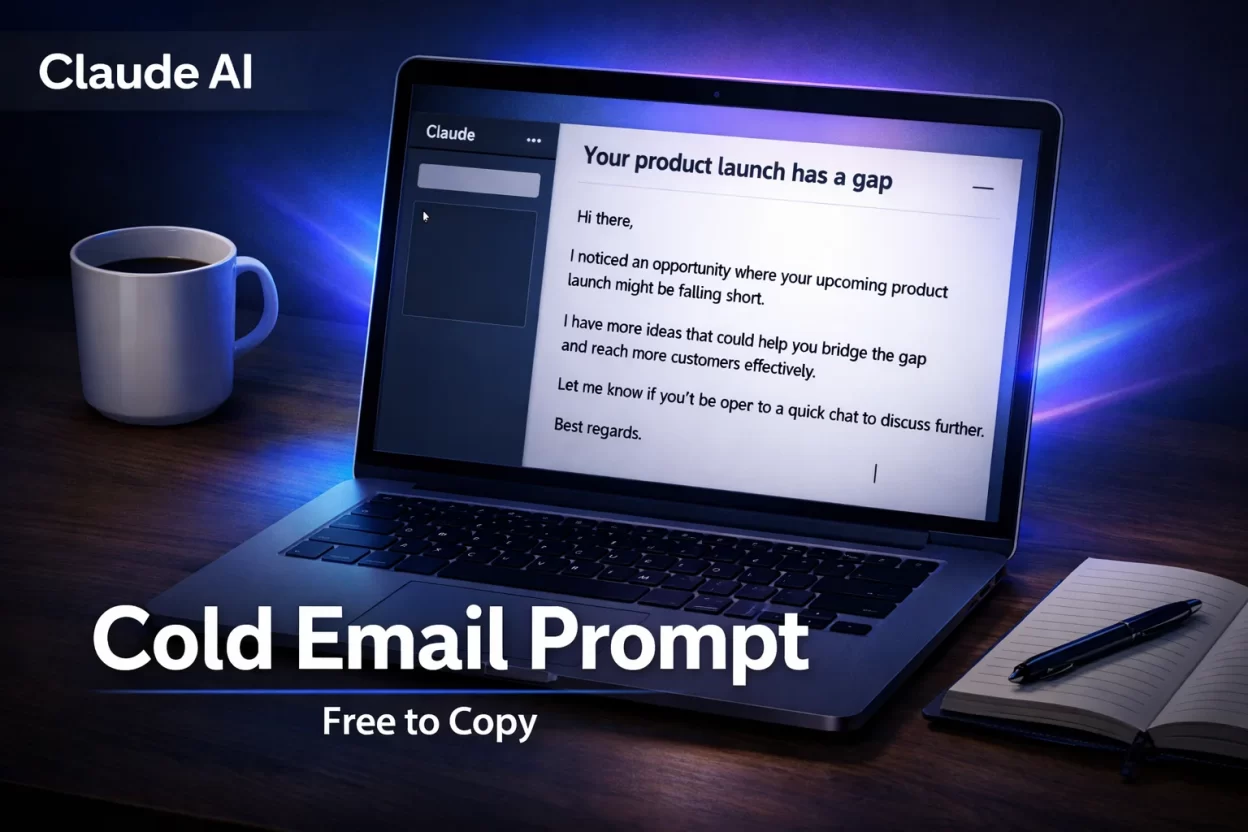
Subject: Your product launch content has a gap
Noticed that [Company] just announced the enterprise tier launch last month. Product launches at that scale usually create more content demand than most marketing teams can handle internally without something slipping.
I am a B2B content writer who helps SaaS companies turn major product moments into SEO content that captures search demand while it is still fresh. For [Similar Company] I wrote a twelve piece launch content series that ranked for fourteen target keywords within three months and drove a measurable uptick in trial signups from organic.
Would a fifteen minute call this week make sense to see if there is a fit? Tuesday or Wednesday morning works well on my end.
Either way the launch content looks strong. Just wanted to flag the gap in case it is useful.
Sarah
That email is 143 words. I made two small edits after Claude generated it and it was ready to send.
Why the Difference Matters
The difference between these two emails is not writing skill. It is structure and specificity. Anyone can write the second email when they have the right prompt guiding them.
Let me break down exactly what changed and why each change matters for your cold email reply rate.
1. Subject line — Curiosity vs. Generic
The first says “Content Writing Services” — tells the recipient nothing new. The second says “Your product launch content has a gap” — creates immediate curiosity and feels personal.
2. Opening line — About them, not you
The first opens with “I hope this email finds you well.” The second opens with a specific observation about their company. The recipient thinks this person knows something about us.
3. Body — One problem vs. a feature dump
The first lists blog posts, articles, web copy, SEO content, and social media posts. The second focuses entirely on one challenge: content demand during a product launch.
4. Proof point — Earned, not announced
The first claims five years of experience at the top. The second shares a specific result after establishing relevance. Context first, credibility second.
5. Call to action — Specific and easy vs. vague and passive
The first says “please do not hesitate to reach out.” The second offers two specific time slots and ends with a pressure-free closing line.
I have tested this exact before and after scenario with people who were skeptical about using Claude for cold email writing. Every single time they read both versions side by side the reaction is the same. The second one actually sounds like someone I would reply to
That is the only metric that matters in cold email outreach. Not how polished the writing looks. Not how many features you mention. Whether the recipient thinks this is worth a reply.
This Claude cold email prompt is designed to produce that reaction consistently. Not occasionally. Every time you use it with honest specific bracket replacements
Start Sending Cold Emails That Actually Get Replies
Most cold outreach emails fail because they are written from the sender’s perspective. This Claude prompt for cold email outreach fixes that by forcing you to think about the recipient first and giving Claude the context it needs to write something worth replying to.
You do not need expensive email writing tools or years of copywriting experience. You need one well-built prompt, five minutes of research on your recipient, and the willingness to fill in every bracket with real details.
This is one of the best AI prompts for email writing I have ever built. Not because it is complicated but because it is structured the right way. Every field exists for a reason. Every constraint shapes the output toward the kind of email that busy people actually respond to.
If you found this prompt useful, the rest of the Claude prompt templates for email on this site cover follow-ups, professional work emails, client proposals, apologies, and job applications. Every one of them is free to copy and built the same way — with specific inputs that produce specific results.
Copy the prompt. Fill in your details. Send the email. Then come back and tell me what happened.
Frequently Asked Questions About Claude Email Prompts
Can Claude write professional emails?
Yes. Claude writes professional emails that sound natural and human when you give it specific context about the recipient, the situation, and the tone you want. The difference between a generic AI email and a professional one is always the quality of the prompt. The Claude prompt for cold email outreach in this post is designed to produce professional quality output every time
Is Claude better than ChatGPT for emails?
For cold outreach emails specifically, yes. Claude produces output with a more natural email tone and style that avoids the overly polished phrasing ChatGPT tends to default to. Claude is also better at staying focused on the recipient rather than the sender, which is the single most important factor in cold email success.
What is the best prompt for email writing?
The best prompt is one that gives the AI detailed context about the recipient, a clear structure to follow, and specific constraints on tone and length. A one-line instruction like “write a cold email” will always produce generic output. The Claude email writing prompts in this post use a bracket system that forces you to provide the right level of detail before Claude writes anything.
How do I make Claude emails sound human?
Three things make the biggest difference. First, fill in every bracket with real specific details — not vague descriptions. Second, read the output out loud and fix anything that sounds stiff. Third, tell Claude to adjust the tone if the first draft feels too formal or too casual. Understanding how to make Claude emails sound human is mostly about giving Claude enough real context to work with.
Are these Claude email prompts free?
Yes. Every Claude AI email prompt in this post is completely free to copy and use. You do not need a paid Claude subscription. The free plan at claude.ai works fine for generating cold outreach emails with this prompt.